
Press Releases & Featured Stories
Kent collaborates with the University of Manchester on low-carbon hydrogen research

Kent has collaborated with the University of Manchester on research exploring the potential of chemical looping reforming as a pathway for low-carbon hydrogen production.
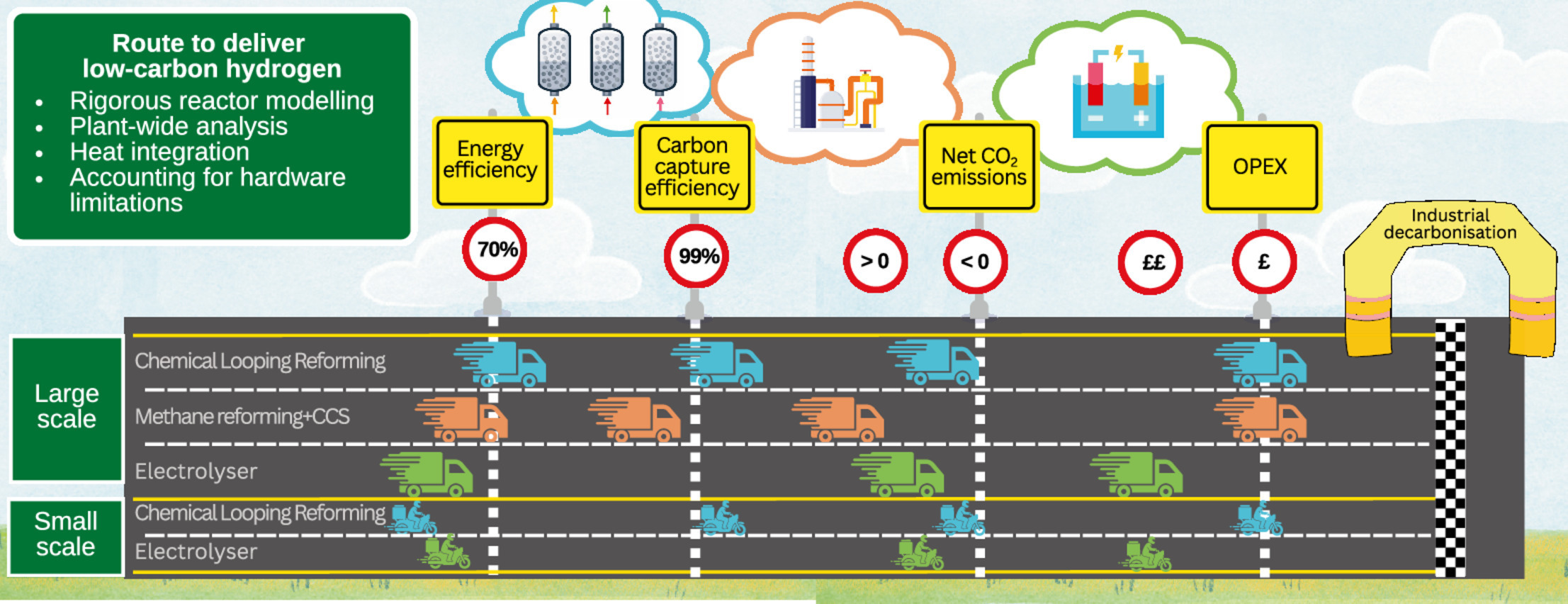
The research, Multi-scale analysis of hydrogen production via chemical looping reforming: reactor and process design, plant-wide performance assessment and benchmarking, evaluates the technology at both 2 MW and 600 MW scales and compares its performance with other scale-relevant hydrogen production technologies.
It examines the potential of packed-bed chemical looping reactors to achieve high thermal efficiency alongside in situ carbon capture, while considering different heat-management strategies, electricity supply scenarios and realistic hardware constraints.
Abstract
The use of low-carbon hydrogen in hard-to-electrify sectors is essential for achieving net-zero targets. This study presents a plant-wide evaluation of chemical looping reforming for low-carbon hydrogen production at 2 MW and 600 MW, with performance compared against scale-relevant benchmark technologies. Using process modelling and simulation, we examine how hydrogen production enabled by packed-bed chemical looping reactors can deliver high thermal efficiency (53%-75%) and in situ carbon capture (90–99%). Three heat-management strategies are proposed to evaluate idealised high-performance layouts and configurations compatible with current hardware. System performance is evaluated under different electricity supply scenarios, with chemical looping reforming showing reduced or potentially net-negative CO2 emissions when steam export is available. Simplified economics are included to compare relative operating cost performance. Overall, this work provides the first assessment of chemical looping reforming under realistic hardware constraints, demonstrating its potential as a competitive pathway for low-carbon hydrogen production across scales.
To explore the research in more detail, read the full paper.
You might also like