
Insights & Opinions
As oil and gas developments become more complex, why early technology selection matters
Written by Ian Long

The oil and gas industry is entering a new phase of development. Many of the conventional, lower-risk resources that underpinned growth for decades have already been discovered and brought into production. Increasingly, operators are turning their attention to more technically challenging opportunities, particularly gas resources containing higher levels of CO₂, H₂S and other contaminants. A number of these resources remain commercially attractive, but they also require a different approach to project development. The challenge is no longer simply extracting the resource. It is understanding how to develop it economically, efficiently, and sustainably from the outset.
In my experience, one of the most important factors in achieving that outcome is technology selection.
As gas resources become more complex, gas treatment technology plays a greater role in determining project success. The technologies selected during the earliest stages of development can influence capital expenditure, operating costs, energy consumption, emissions performance, operability and future flexibility. Decisions made during concept development often shape the direction of a project long before FEED begins.
This is particularly relevant for gas treatment, where no single solution is universally applicable. The most effective technology depends on the composition of the gas, the required product specification, and the broader objectives of the development. A solution that performs exceptionally well in one application may be entirely unsuitable in another.
For that reason, selecting technology should not begin with preferred solutions. It should begin with understanding the treatment challenge itself.
A framework that has stood the test of time
One reason the Tennyson and Schaaf methodology remains widely referenced more than fifty years after its publication is that it captures a principle that is just as relevant today as it was in 19775: The right technology depends on the problem you are trying to solve.
The Tennyson and Schaaf screening charts provide a practical framework for evaluating acid gas treatment technologies by comparing feed inlet gas conditions with the required product outlet gas specification.
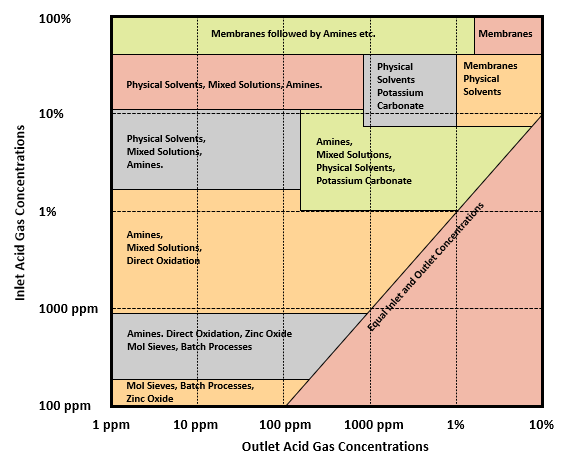
At a high level, the chart maps acid gas partial pressure in the inlet feed stream against the acid gas partial pressure required in the outlet treated gas. This creates distinct operating envelopes where different technologies are typically most effective.
Several broad trends emerge:
- Higher acid gas feed concentrations often favour membranes or physical solvents for bulk contaminant removal.
- Where high contaminant levels must also meet stringent outlet product specifications, hybrid solutions (e.g membranes or physical solvents followed by amines) may provide the most effective balance of performance and cost.
- As feed acid gas concentrations decrease, chemical absorption technologies such as amines often become increasingly attractive.
- At very low feed contaminant concentrations, polishing technologies such as molecular sieves or zinc oxide beds may be required to achieve final specifications.
What makes the methodology valuable is not that it identifies a single answer. Rather, it provides a structured way of understanding which technologies are likely to be most appropriate for a given application.
From Technology Selection to Development Strategy
While the original methodology remains highly relevant, the context in which it is applied has evolved.
Today's projects frequently face higher impurity levels, more demanding environmental requirements, and increasing pressure to reduce emissions intensity. As a result, technology selection can influence far more than processing performance alone.
Choices made during concept development may affect energy efficiency, carbon management strategies, operating costs, and long-term asset performance. This means technology selection is no longer solely a process engineering decision. It has become a development strategy decision. The earlier project teams understand the realistic technology pathways available to them, the better positioned they are to evaluate trade-offs, manage risk, and optimise project value.
As the industry continues to unlock increasingly challenging gas resources, successful developments will depend on more than technical execution. They will depend on understanding the resource, recognising the available technology options, and selecting the most appropriate solution as early as possible.
Those that do so effectively will be best placed to unlock the next generation of gas developments.
You might also like